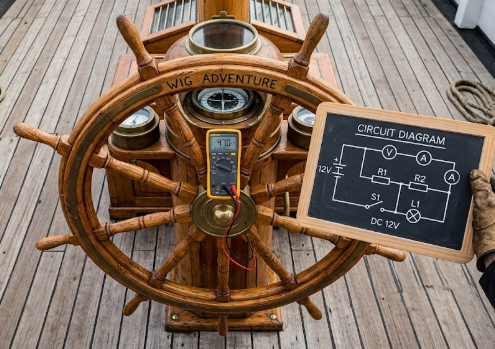
This course provides the foundational knowledge required to understand and work safely with shipboard electrical and electronic systems. Training includes direct-current (DC) theory, basic electrical concepts, Ohm’s Law, power and energy, and the principles of electric fields, capacitors, magnetism, and inductive components. Students also learn alternating-current (AC) theory, including alternating voltage, reactance, impedance, and resonance circuits. The course covers semiconductor principles, the operation of diodes and transistors, basic amplifier circuits, and oscillatory circuits. Emphasis is placed on developing a solid technical foundation to support further training in marine electrical engineering and safe onboard electrical practices.
Physics 4

200,00 €